
 Image 1 of 1
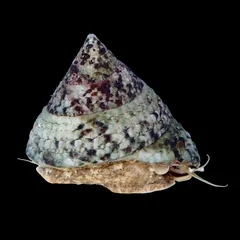
The Astraea Turban Snail (Astraea tecta), also widely known as the Astraea Cone Snail or Star Snail, is an exceptionally popular and highly functional marine gastropod featuring a heavy, pyramid-shaped shell with distinct ridges that resemble a star when viewed from above. Celebrated in the saltwater hobby as a foundational member of the clean-up crew, this industrious herbivore spends its entire day slowly pacing across rockwork and aquarium glass. It is a tireless utility worker introduced specifically to scrape away film algae before it can overtake a marine system.
Tank Requirements
Minimum Tank Size: 5 to 10 gallons or larger; highly versatile and suitable for any system size, provided there is an established layer of microalgae growth.
Aquarium Decor: Plentiful configurations of live rock and clean glass surfaces. It does not require a sandbed, but its heavy shell means that all structural live rock should be securely stacked to prevent minor shifts as it crawls.
Temperature: 72°F – 78°F (22°C – 26°C).
Salinity (Specific Gravity): 1.023 – 1.025; highly sensitive to rapid osmotic shifts, high nitrate levels, and copper-based medications.
pH Range: 8.1 – 8.4; requires stable calcium and alkalinity levels to grow and maintain its thick shell.
Care and Feeding
Diet: Herbivore; it is a specialized grazer that feeds continuously on green hair algae, film algae, diatoms, and cyanobacteria. Unlike meat-scavenging snails, it will completely ignore leftover fish food and fish waste. If the aquarium becomes overly clean and lacks natural algae growth, its diet must be supplemented by rubber-banding dried seaweed sheets to a rock.
Reef Safe Rating: Reef safe; it is completely harmless toward small polyp stony (SPS) corals, large polyp stony (LPS) corals, soft corals, and mobile invertebrates.
Temperament: Peaceful; entirely docile and sluggish. Its major vulnerability is that it cannot right itself if it falls upside down on a soft sandbed or flat surface. If left inverted, it will quickly starve or become an easy meal for opportunistic predators, requiring the aquarist to manually flip it back over.
The Astraea Turban Snail (Astraea tecta), also widely known as the Astraea Cone Snail or Star Snail, is an exceptionally popular and highly functional marine gastropod featuring a heavy, pyramid-shaped shell with distinct ridges that resemble a star when viewed from above. Celebrated in the saltwater hobby as a foundational member of the clean-up crew, this industrious herbivore spends its entire day slowly pacing across rockwork and aquarium glass. It is a tireless utility worker introduced specifically to scrape away film algae before it can overtake a marine system.
Tank Requirements
Minimum Tank Size: 5 to 10 gallons or larger; highly versatile and suitable for any system size, provided there is an established layer of microalgae growth.
Aquarium Decor: Plentiful configurations of live rock and clean glass surfaces. It does not require a sandbed, but its heavy shell means that all structural live rock should be securely stacked to prevent minor shifts as it crawls.
Temperature: 72°F – 78°F (22°C – 26°C).
Salinity (Specific Gravity): 1.023 – 1.025; highly sensitive to rapid osmotic shifts, high nitrate levels, and copper-based medications.
pH Range: 8.1 – 8.4; requires stable calcium and alkalinity levels to grow and maintain its thick shell.
Care and Feeding
Diet: Herbivore; it is a specialized grazer that feeds continuously on green hair algae, film algae, diatoms, and cyanobacteria. Unlike meat-scavenging snails, it will completely ignore leftover fish food and fish waste. If the aquarium becomes overly clean and lacks natural algae growth, its diet must be supplemented by rubber-banding dried seaweed sheets to a rock.
Reef Safe Rating: Reef safe; it is completely harmless toward small polyp stony (SPS) corals, large polyp stony (LPS) corals, soft corals, and mobile invertebrates.
Temperament: Peaceful; entirely docile and sluggish. Its major vulnerability is that it cannot right itself if it falls upside down on a soft sandbed or flat surface. If left inverted, it will quickly starve or become an easy meal for opportunistic predators, requiring the aquarist to manually flip it back over.