
 Image 1 of 1
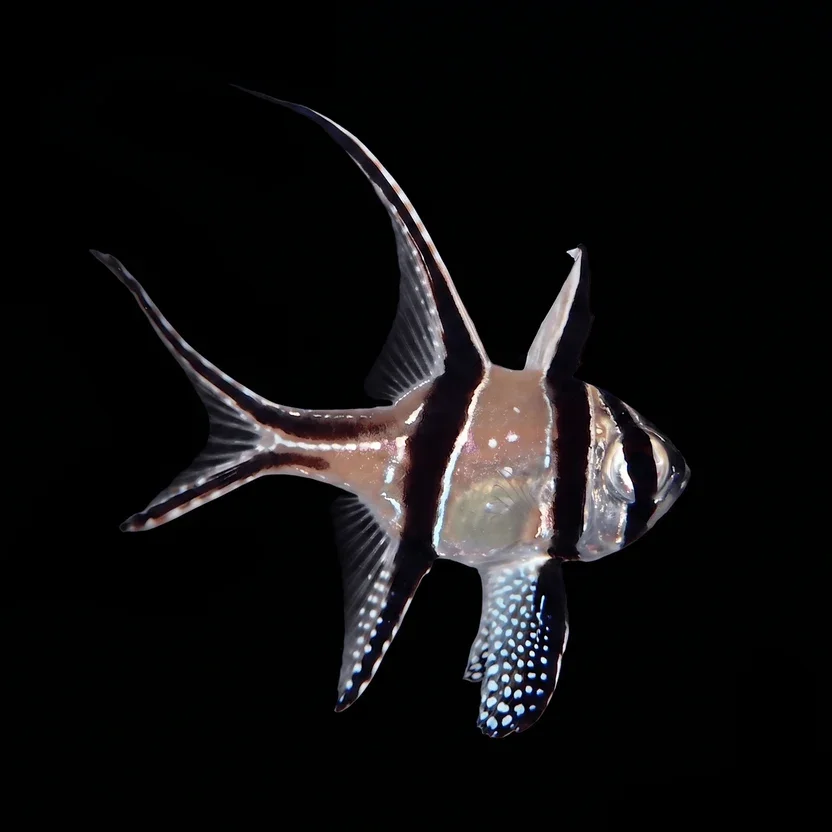
The Banggai Cardinalfish (Pterapogon kauderni) is an iconic, elegant, and visually striking marine fish featuring a highly compressed, disk-shaped silver body adorned with bold black vertical bars and a dense speckling of brilliant white dots across its long, flowing fins. Instantly recognizable by its unique, deeply forked dorsal and caudal fins, this species is famous in the saltwater hobby for its gentle, hovering swimming style and its fascinating reproductive biology as a paternal mouthbrooder.
Tank Requirements
Minimum Tank Size: 30 gallons or larger; its slow-moving, stationary hovering habits make it an exceptional candidate for nano and mid-sized reef layouts.
Aquarium Decor: Plentiful live rock structures forming large caves and vertical overhangs, or artificial decorations like long-spined sea urchin replicas where it can hover safely for cover.
Temperature: 72°F – 78°F (22°C – 26°C).
Salinity (Specific Gravity): 1.020 – 1.025.
pH Range: 8.1 – 8.4.
Care and Feeding
Diet: Carnivore; can sometimes be hesitant to accept dry foods initially. Requires a varied daily menu consisting of frozen mysis shrimp, enriched brine shrimp, copepods, and finely chopped marine seafoods, though many will eventually acclimate to high-quality pellets.
Reef Safe Rating: Reef safe; it is completely peaceful and harmless toward small polyp stony (SPS) corals, large polyp stony (LPS) corals, soft corals, and clam mantles, never nipping at tissue.
Temperament: Peaceful to semi-aggressive; it is exceptionally docile toward unrelated community tank mates. However, they establish a strict hierarchy among their own kind; while a bonded male-female pair will coexist beautifully, multiple individuals of the same sex will fight fiercely in small systems, so they are best kept singly or as a single verified pair.
The Banggai Cardinalfish (Pterapogon kauderni) is an iconic, elegant, and visually striking marine fish featuring a highly compressed, disk-shaped silver body adorned with bold black vertical bars and a dense speckling of brilliant white dots across its long, flowing fins. Instantly recognizable by its unique, deeply forked dorsal and caudal fins, this species is famous in the saltwater hobby for its gentle, hovering swimming style and its fascinating reproductive biology as a paternal mouthbrooder.
Tank Requirements
Minimum Tank Size: 30 gallons or larger; its slow-moving, stationary hovering habits make it an exceptional candidate for nano and mid-sized reef layouts.
Aquarium Decor: Plentiful live rock structures forming large caves and vertical overhangs, or artificial decorations like long-spined sea urchin replicas where it can hover safely for cover.
Temperature: 72°F – 78°F (22°C – 26°C).
Salinity (Specific Gravity): 1.020 – 1.025.
pH Range: 8.1 – 8.4.
Care and Feeding
Diet: Carnivore; can sometimes be hesitant to accept dry foods initially. Requires a varied daily menu consisting of frozen mysis shrimp, enriched brine shrimp, copepods, and finely chopped marine seafoods, though many will eventually acclimate to high-quality pellets.
Reef Safe Rating: Reef safe; it is completely peaceful and harmless toward small polyp stony (SPS) corals, large polyp stony (LPS) corals, soft corals, and clam mantles, never nipping at tissue.
Temperament: Peaceful to semi-aggressive; it is exceptionally docile toward unrelated community tank mates. However, they establish a strict hierarchy among their own kind; while a bonded male-female pair will coexist beautifully, multiple individuals of the same sex will fight fiercely in small systems, so they are best kept singly or as a single verified pair.