
 Image 1 of 1
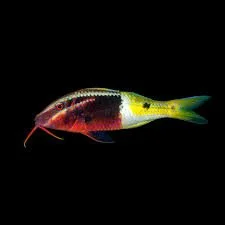
The Bicolor Goatfish (Parupeneus barberinoides), also widely known as the Swarthy Goatfish or Half-and-Half Goatfish, is a fascinating and highly active marine species featuring a distinct color split that divides its body sharply into a dark reddish-black front half and a creamy-white to yellowish rear half. A prominent black spot is located near the base of its tail fin, and its face is accented by a vibrant red iris. This species is famous for the two long, highly flexible barbels (whiskers) beneath its chin, which contain advanced chemical sensors that it uses to continuously plow, shift, and sift through the sandbed to locate hidden prey.
Tank Requirements
Minimum Tank Size: 125 gallons or larger; as a fast-growing and continuous bottom-dweller, it demands a massive sandbed surface area to support its constant foraging.
Aquarium Decor: It absolutely demands a vast, open, and deep sandbed (at least 2 inches) composed of fine, smooth aragonite substrate. It cannot survive in bare-bottom tanks or setups with coarse gravel or heavy crushed coral rubble, which will painfully erode its sensitive chin barbels.
Temperature: 72°F – 78°F (22°C – 26°C).
Salinity (Specific Gravity): 1.020 – 1.025.
pH Range: 8.1 – 8.4.
Care and Feeding
Diet: Carnivore; possesses a very high metabolism and requires multiple heavy daily feedings. It must be offered a variety of meaty frozen foods such as vitamin-enriched mysis shrimp, brine shrimp, bloodworms, and finely chopped fresh seafoods (clams, squid, or krill) targeted directly toward the sandbed.
Reef Safe Rating: Reef safe with caution; it is completely harmless to small polyp stony (SPS) corals, large polyp stony (LPS) corals, and soft corals. However, it is an active threat to small sand-dwelling invertebrates, meaning it will readily consume small ornamental shrimp, micro-crabs, small feather dusters, and beneficial sand worms.
Temperament: Peaceful; it is entirely docile and non-aggressive toward unrelated water-column tank mates. However, its frantic and continuous sand-plowing behavior can easily stress out shy, nocturnal sand-dwellers or disrupt delicate bottom-dwelling fish like small gobies.
The Bicolor Goatfish (Parupeneus barberinoides), also widely known as the Swarthy Goatfish or Half-and-Half Goatfish, is a fascinating and highly active marine species featuring a distinct color split that divides its body sharply into a dark reddish-black front half and a creamy-white to yellowish rear half. A prominent black spot is located near the base of its tail fin, and its face is accented by a vibrant red iris. This species is famous for the two long, highly flexible barbels (whiskers) beneath its chin, which contain advanced chemical sensors that it uses to continuously plow, shift, and sift through the sandbed to locate hidden prey.
Tank Requirements
Minimum Tank Size: 125 gallons or larger; as a fast-growing and continuous bottom-dweller, it demands a massive sandbed surface area to support its constant foraging.
Aquarium Decor: It absolutely demands a vast, open, and deep sandbed (at least 2 inches) composed of fine, smooth aragonite substrate. It cannot survive in bare-bottom tanks or setups with coarse gravel or heavy crushed coral rubble, which will painfully erode its sensitive chin barbels.
Temperature: 72°F – 78°F (22°C – 26°C).
Salinity (Specific Gravity): 1.020 – 1.025.
pH Range: 8.1 – 8.4.
Care and Feeding
Diet: Carnivore; possesses a very high metabolism and requires multiple heavy daily feedings. It must be offered a variety of meaty frozen foods such as vitamin-enriched mysis shrimp, brine shrimp, bloodworms, and finely chopped fresh seafoods (clams, squid, or krill) targeted directly toward the sandbed.
Reef Safe Rating: Reef safe with caution; it is completely harmless to small polyp stony (SPS) corals, large polyp stony (LPS) corals, and soft corals. However, it is an active threat to small sand-dwelling invertebrates, meaning it will readily consume small ornamental shrimp, micro-crabs, small feather dusters, and beneficial sand worms.
Temperament: Peaceful; it is entirely docile and non-aggressive toward unrelated water-column tank mates. However, its frantic and continuous sand-plowing behavior can easily stress out shy, nocturnal sand-dwellers or disrupt delicate bottom-dwelling fish like small gobies.