
 Image 1 of 1
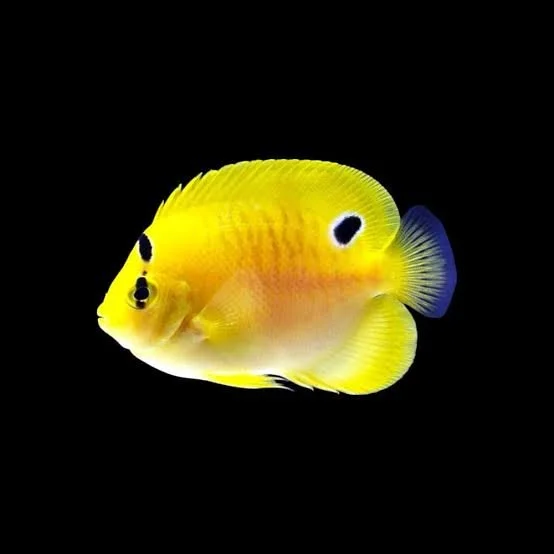
The Flagfin Angelfish (Apolemichthys trimaculatus), also known as the Three-Spot Angelfish, is a highly prized and visually striking marine species featuring a brilliant, solid neon-yellow body contrasted by a stark black-trimmed anal fin and vibrant blue lips. It takes its three-spot name from three distinct dark markings: one prominent black spot on its forehead crown, and a faint dark smudge positioned just behind each eye. Growing to an intermediate size between dwarf and giant angelfish, it is an elegant centerpiece species that demands an established ecosystem and careful handling to transition smoothly into aquarium life.
Tank Requirements
Minimum Tank Size: 100 to 125 gallons or larger; a spacious horizontal footprint is essential to reduce stress and prevent wall-pacing behavior.
Aquarium Decor: Elaborate networks of mature live rock forming multiple deep caves, large arches, and overhangs where it can claim a home territory and shelter from bright lighting.
Temperature: 72°F – 78°F (22°C – 26°C).
Salinity (Specific Gravity): 1.020 – 1.025.
pH Range: 8.1 – 8.4.
Care and Feeding
Diet: Omnivore; can be a notoriously picky eater during initial acclimation. Requires a varied diet consisting of vitamin-enriched mysis shrimp, frozen krill, chopped fresh clams, marine algae sheets (nori), and specialized angelfish preparations containing natural sponge matter to mimic its wild foraging habits.
Reef Safe Rating: Not reef safe; it is an active, persistent picker that will readily nip at the fleshy polyps of large polyp stony (LPS) corals, soft leather corals, zoanthids, and delicate clam mantles. It is best suited for a fish-only-with-live-rock (FOWLR) system.
Temperament: Semi-aggressive; generally peaceful and somewhat timid toward unrelated community tank mates when first introduced. However, it will become highly territorial toward its own kind, other closely related species, or any similarly shaped yellow fish, and should be kept as a single specimen.
The Flagfin Angelfish (Apolemichthys trimaculatus), also known as the Three-Spot Angelfish, is a highly prized and visually striking marine species featuring a brilliant, solid neon-yellow body contrasted by a stark black-trimmed anal fin and vibrant blue lips. It takes its three-spot name from three distinct dark markings: one prominent black spot on its forehead crown, and a faint dark smudge positioned just behind each eye. Growing to an intermediate size between dwarf and giant angelfish, it is an elegant centerpiece species that demands an established ecosystem and careful handling to transition smoothly into aquarium life.
Tank Requirements
Minimum Tank Size: 100 to 125 gallons or larger; a spacious horizontal footprint is essential to reduce stress and prevent wall-pacing behavior.
Aquarium Decor: Elaborate networks of mature live rock forming multiple deep caves, large arches, and overhangs where it can claim a home territory and shelter from bright lighting.
Temperature: 72°F – 78°F (22°C – 26°C).
Salinity (Specific Gravity): 1.020 – 1.025.
pH Range: 8.1 – 8.4.
Care and Feeding
Diet: Omnivore; can be a notoriously picky eater during initial acclimation. Requires a varied diet consisting of vitamin-enriched mysis shrimp, frozen krill, chopped fresh clams, marine algae sheets (nori), and specialized angelfish preparations containing natural sponge matter to mimic its wild foraging habits.
Reef Safe Rating: Not reef safe; it is an active, persistent picker that will readily nip at the fleshy polyps of large polyp stony (LPS) corals, soft leather corals, zoanthids, and delicate clam mantles. It is best suited for a fish-only-with-live-rock (FOWLR) system.
Temperament: Semi-aggressive; generally peaceful and somewhat timid toward unrelated community tank mates when first introduced. However, it will become highly territorial toward its own kind, other closely related species, or any similarly shaped yellow fish, and should be kept as a single specimen.