
 Image 1 of 1
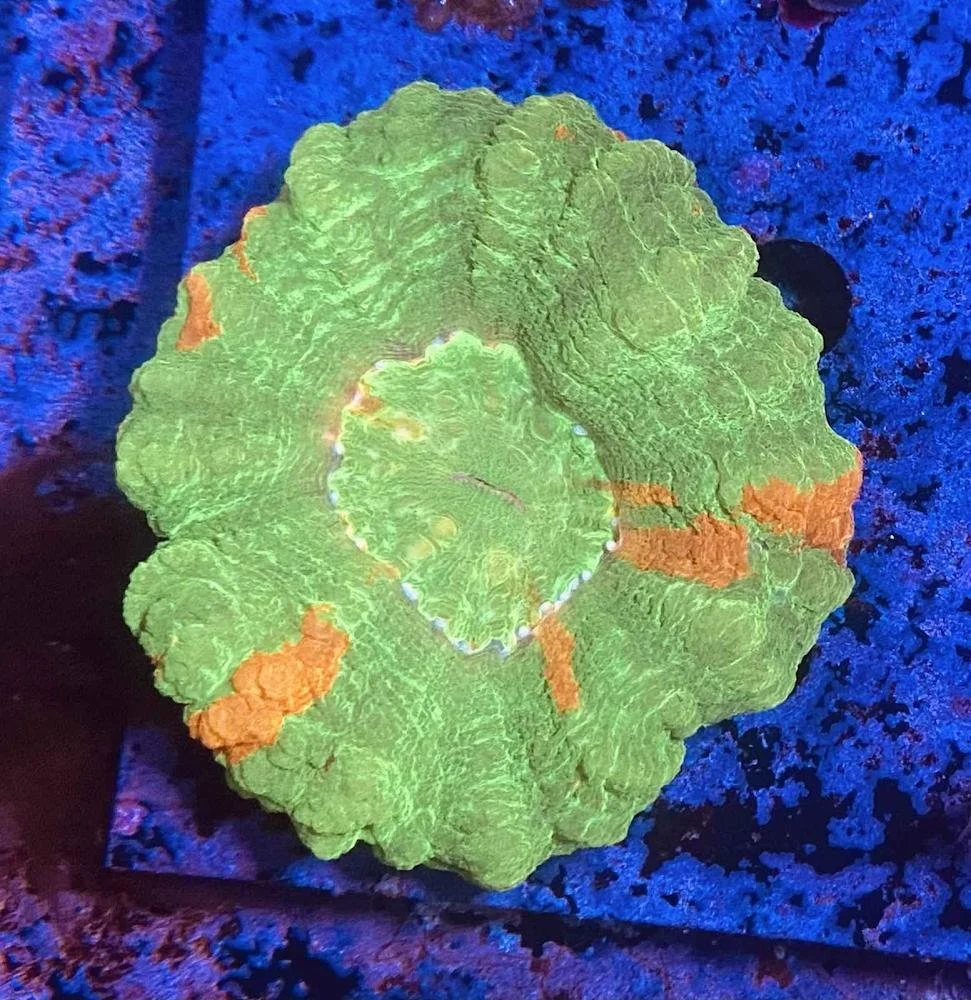
The Green and Orange Scolymia (Homophyllia australis), often referred to as a Reverse Bleeding Apple or Green Splatter Scoly, is an exquisite single-polyp large polyp stony (LPS) coral featuring a dominant neon green body splashed with irregular, contrasting streaks of fiery orange. Prized by reef collectors for its vibrant color pop on the lower levels of a display tank, it thrives under low-to-moderate lighting and calm currents, offering a robust but visually stunning sandbed centerpiece.
Tank Requirements
Lighting: Low to moderate (30–120 PAR); subdued, indirect illumination is highly recommended, as intense lighting will stress the polyp, cause tissue retraction, and degrade its bright green pigments.
Water Flow: Low and gentle; requires a mild, fluid current to clear away mucus coats and organic waste without forcing its fleshy mantle to flatten against its sharp internal skeleton.
Temperature: 72°F – 78°F (22°C – 26°C).
Salinity (Specific Gravity): 1.023 – 1.025.
pH Range: 8.1 – 8.4.
Care and Feeding
Placement: Bottom of the aquarium, placed flat on a stable, soft sandbed or nestled securely into low-profile rubble where it cannot slide, flip over, or get irritated by shifting substrate.
Diet: Photosynthetic via zooxanthellae, but exhibits a massive feeding response at night and grows best with regular spot-feeding of meaty foods like mysis shrimp or specialized high-grade LPS pellets.
Temperament: Peaceful; it completely lacks aggressive sweeper tentacles, allowing it to touch other color variations of the same Homophyllia australis species safely without any territorial conflict.
The Green and Orange Scolymia (Homophyllia australis), often referred to as a Reverse Bleeding Apple or Green Splatter Scoly, is an exquisite single-polyp large polyp stony (LPS) coral featuring a dominant neon green body splashed with irregular, contrasting streaks of fiery orange. Prized by reef collectors for its vibrant color pop on the lower levels of a display tank, it thrives under low-to-moderate lighting and calm currents, offering a robust but visually stunning sandbed centerpiece.
Tank Requirements
Lighting: Low to moderate (30–120 PAR); subdued, indirect illumination is highly recommended, as intense lighting will stress the polyp, cause tissue retraction, and degrade its bright green pigments.
Water Flow: Low and gentle; requires a mild, fluid current to clear away mucus coats and organic waste without forcing its fleshy mantle to flatten against its sharp internal skeleton.
Temperature: 72°F – 78°F (22°C – 26°C).
Salinity (Specific Gravity): 1.023 – 1.025.
pH Range: 8.1 – 8.4.
Care and Feeding
Placement: Bottom of the aquarium, placed flat on a stable, soft sandbed or nestled securely into low-profile rubble where it cannot slide, flip over, or get irritated by shifting substrate.
Diet: Photosynthetic via zooxanthellae, but exhibits a massive feeding response at night and grows best with regular spot-feeding of meaty foods like mysis shrimp or specialized high-grade LPS pellets.
Temperament: Peaceful; it completely lacks aggressive sweeper tentacles, allowing it to touch other color variations of the same Homophyllia australis species safely without any territorial conflict.