
 Image 1 of 1
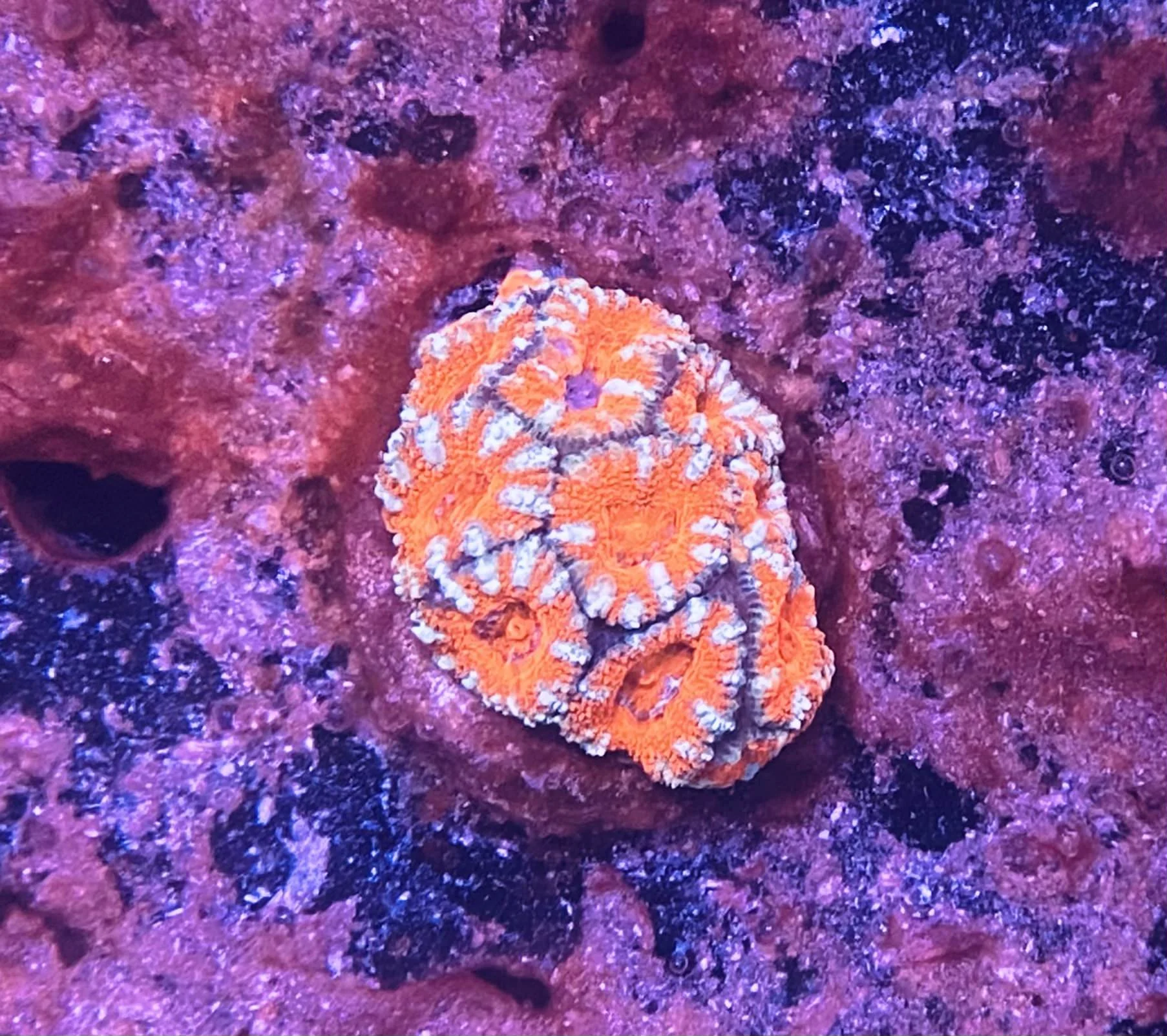
The Orange Acan Lord Coral (Micromussa lordhowensis, formerly Acanthastrea lordhowensis), commonly called an Acan Lord, is a hardy and highly sought-after large polyp stony (LPS) coral featuring clusters of small, plump, uniform corallites. Popular for its brilliant contrasting bands of fiery orange and frosty white rims, it is exceptionally resilient and grows by encrusting over rockwork, making it a perfect low-profile addition for both beginners and collectors.
Tank Requirements
Lighting: Low to moderate (30–150 PAR); too much light will quickly bleach its brilliant orange pigments and cause the fleshy polyps to retract.
Water Flow: Low to moderate; prefers a gentle, swaying current that allows the polyps to fully inflate into a puffy, pillow-like appearance.
Temperature: 72°F – 78°F (22°C – 26°C).
Salinity (Specific Gravity): 1.023 – 1.025.
pH Range: 8.1 – 8.4.
Care and Feeding
Placement: Bottom to middle sections of the aquarium, glued to a low rock ledge or resting on rubble where its base can slowly encrust over the substrate.
Diet: Photosynthetic via zooxanthellae, but possesses a ferocious feeding response and grows significantly faster when target-fed weekly with mysis shrimp, fauna pellets, or powdered reef foods.
Temperament: Semi-aggressive; it has short stinging tentacles that it extends at night to protect its immediate perimeter, so it must be kept spaced a few inches away from other coral species.
The Orange Acan Lord Coral (Micromussa lordhowensis, formerly Acanthastrea lordhowensis), commonly called an Acan Lord, is a hardy and highly sought-after large polyp stony (LPS) coral featuring clusters of small, plump, uniform corallites. Popular for its brilliant contrasting bands of fiery orange and frosty white rims, it is exceptionally resilient and grows by encrusting over rockwork, making it a perfect low-profile addition for both beginners and collectors.
Tank Requirements
Lighting: Low to moderate (30–150 PAR); too much light will quickly bleach its brilliant orange pigments and cause the fleshy polyps to retract.
Water Flow: Low to moderate; prefers a gentle, swaying current that allows the polyps to fully inflate into a puffy, pillow-like appearance.
Temperature: 72°F – 78°F (22°C – 26°C).
Salinity (Specific Gravity): 1.023 – 1.025.
pH Range: 8.1 – 8.4.
Care and Feeding
Placement: Bottom to middle sections of the aquarium, glued to a low rock ledge or resting on rubble where its base can slowly encrust over the substrate.
Diet: Photosynthetic via zooxanthellae, but possesses a ferocious feeding response and grows significantly faster when target-fed weekly with mysis shrimp, fauna pellets, or powdered reef foods.
Temperament: Semi-aggressive; it has short stinging tentacles that it extends at night to protect its immediate perimeter, so it must be kept spaced a few inches away from other coral species.