
 Image 1 of 1
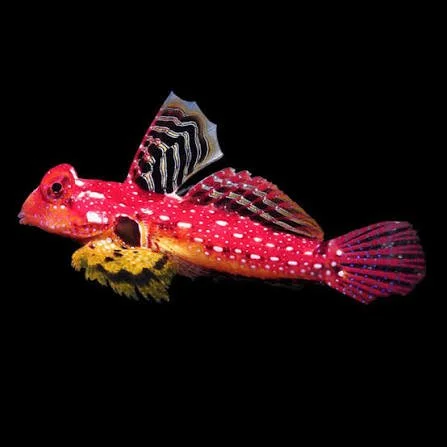
The Red Scooter Blenny (Synchiropus stellatus), more accurately classified as a dragonet rather than a true blenny, is a highly charismatic, bottom-dwelling marine fish featuring an intricately mottled reddish-brown body covered in starry white and dark blotches. Famous for its large, expressive eyes that swivel independently and its elaborate, fan-like dorsal fin that it erects to display, it hops across the substrate and rockwork like a miniature hovercraft. It is highly valued for bringing constant, fascinating movement to the sandbed, though it requires a specialized mature ecosystem to satisfy its strict feeding habits.
Tank Requirements
Minimum Tank Size: 30 gallons or larger; demands a highly mature, well-established biological system to ensure a steady food supply.
Aquarium Decor: Abundant live rock formations arranged to maximize surface area, paired with a soft, fine aragonite sandbed. A refugium packed with macroalgae is highly recommended to continuously seed the main display with live prey.
Temperature: 72°F – 78°F (22°C – 26°C).
Salinity (Specific Gravity): 1.020 – 1.025.
pH Range: 8.1 – 8.4.
Care and Feeding
Diet: Strict Carnivore and Micro-predator; it feeds almost exclusively on live copepods and amphipods that naturally inhabit live rock. Because it continuously hunts for live micro-crustaceans throughout the day, it will quickly starve in young or overly clean tanks. It must be supplemented with live copepod cultures unless it is meticulously trained to accept frozen baby mysis shrimp or enriched brine shrimp.
Reef Safe Rating: Reef safe; it is completely harmless toward small polyp stony (SPS) corals, large polyp stony (LPS) corals, soft corals, polyps, and macroalgae, making it a perfect model citizen for reef tanks.
Temperament: Peaceful; completely docile toward all unrelated community tank mates. However, males can become highly aggressive toward other male dragonets or similarly shaped species, so they should be kept singly or as a verified male-female pair.
The Red Scooter Blenny (Synchiropus stellatus), more accurately classified as a dragonet rather than a true blenny, is a highly charismatic, bottom-dwelling marine fish featuring an intricately mottled reddish-brown body covered in starry white and dark blotches. Famous for its large, expressive eyes that swivel independently and its elaborate, fan-like dorsal fin that it erects to display, it hops across the substrate and rockwork like a miniature hovercraft. It is highly valued for bringing constant, fascinating movement to the sandbed, though it requires a specialized mature ecosystem to satisfy its strict feeding habits.
Tank Requirements
Minimum Tank Size: 30 gallons or larger; demands a highly mature, well-established biological system to ensure a steady food supply.
Aquarium Decor: Abundant live rock formations arranged to maximize surface area, paired with a soft, fine aragonite sandbed. A refugium packed with macroalgae is highly recommended to continuously seed the main display with live prey.
Temperature: 72°F – 78°F (22°C – 26°C).
Salinity (Specific Gravity): 1.020 – 1.025.
pH Range: 8.1 – 8.4.
Care and Feeding
Diet: Strict Carnivore and Micro-predator; it feeds almost exclusively on live copepods and amphipods that naturally inhabit live rock. Because it continuously hunts for live micro-crustaceans throughout the day, it will quickly starve in young or overly clean tanks. It must be supplemented with live copepod cultures unless it is meticulously trained to accept frozen baby mysis shrimp or enriched brine shrimp.
Reef Safe Rating: Reef safe; it is completely harmless toward small polyp stony (SPS) corals, large polyp stony (LPS) corals, soft corals, polyps, and macroalgae, making it a perfect model citizen for reef tanks.
Temperament: Peaceful; completely docile toward all unrelated community tank mates. However, males can become highly aggressive toward other male dragonets or similarly shaped species, so they should be kept singly or as a verified male-female pair.