
 Image 1 of 1
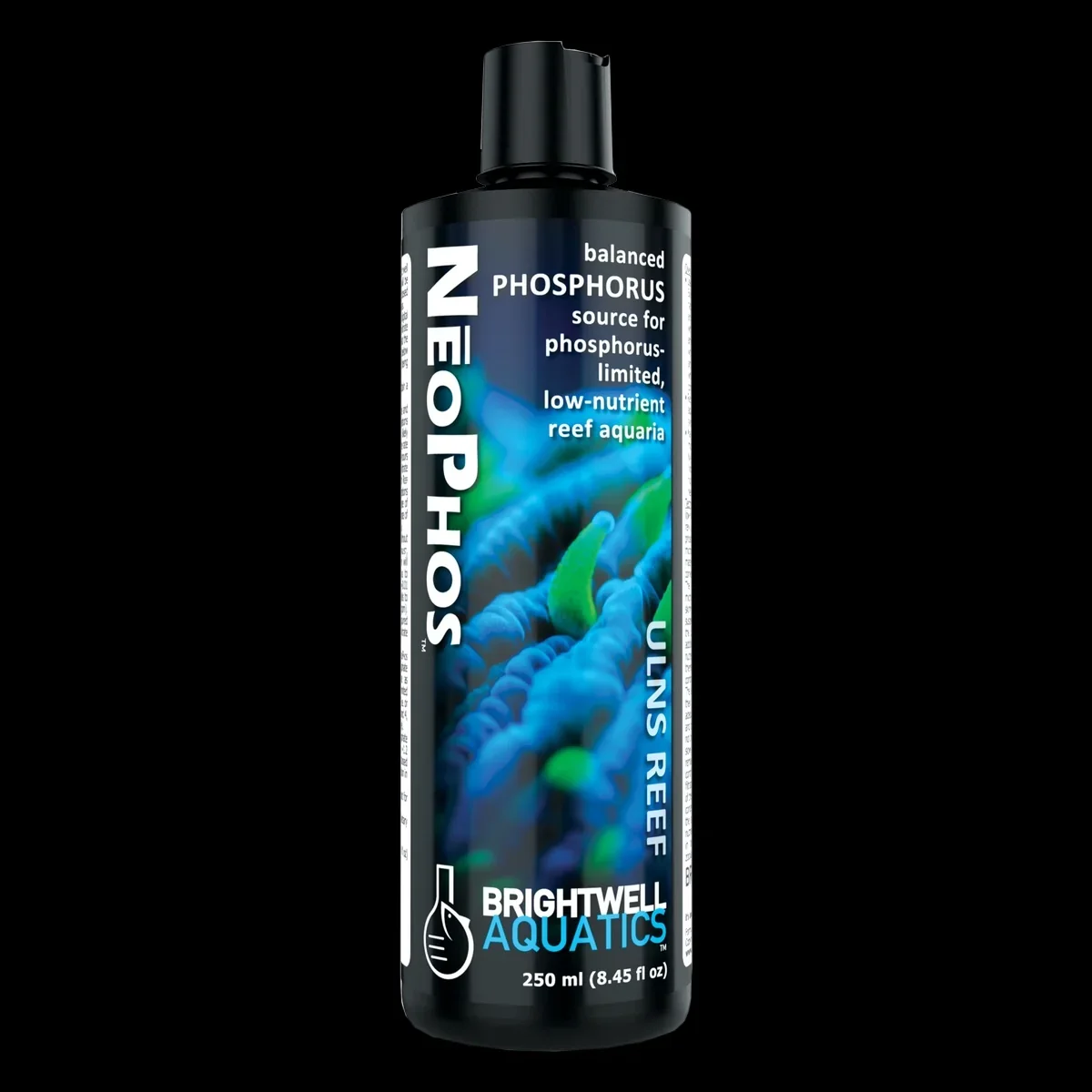
The Brightwell NeoPhos is a phosphate source for ultra-low nutrient systems where PO₄ has dropped below the biologically useful range. Formulated in the United States by Brightwell Aquatics, it supplies the phosphorus beneficial microbes need to keep absorbing and eliminating organic waste in a reef aquarium running on a probiotic method or carbon dosing.
On a ULNS, a too-low PO₄ blocks biology the same way a too-low NO₃ does — microbial capacity to break down ammonia, nitrite, and nitrate depends on the simultaneous availability of carbon, nitrogen, and phosphorus. NeoPhos brings PO₄ back into the 0.01 to 0.02 ppm target range while the system keeps processing organic excess.
Phosphorus-limited SPS ULNS tanks — corals pale out, tissue recedes because PO₄ is too low for biology to consume excess NO₃.
Unbalanced probiotic routine — NP Pro, Bio S, or similar that has dropped PO₄ below 0.01 ppm and blocked nitrogen uptake.
Heavy Berlin-method tanks — aggressive skimming and very porous rock that have exported all residual PO₄.
ICP correction — an ICP-OES or ICP-MS reading confirming dissolved PO₄ below the reef useful range.
The Brightwell NeoPhos is a phosphate source for ultra-low nutrient systems where PO₄ has dropped below the biologically useful range. Formulated in the United States by Brightwell Aquatics, it supplies the phosphorus beneficial microbes need to keep absorbing and eliminating organic waste in a reef aquarium running on a probiotic method or carbon dosing.
On a ULNS, a too-low PO₄ blocks biology the same way a too-low NO₃ does — microbial capacity to break down ammonia, nitrite, and nitrate depends on the simultaneous availability of carbon, nitrogen, and phosphorus. NeoPhos brings PO₄ back into the 0.01 to 0.02 ppm target range while the system keeps processing organic excess.
Phosphorus-limited SPS ULNS tanks — corals pale out, tissue recedes because PO₄ is too low for biology to consume excess NO₃.
Unbalanced probiotic routine — NP Pro, Bio S, or similar that has dropped PO₄ below 0.01 ppm and blocked nitrogen uptake.
Heavy Berlin-method tanks — aggressive skimming and very porous rock that have exported all residual PO₄.
ICP correction — an ICP-OES or ICP-MS reading confirming dissolved PO₄ below the reef useful range.