
 Image 1 of 1
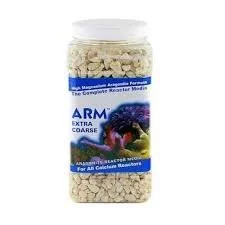
CaribSea A.R.M. (Aquarium Reactor Media) Extra Coarse is a professional, high-purity aragonite calcium reactor media engineered to deliver a complete, balanced blend of calcium, carbonate alkalinity, and essential trace elements to demanding marine reef displays. Composed of natural marine aragonite, its largest grain size format is custom-tailored to prevent standard compaction, maximize carbon dioxide (CO₂) penetration, and minimize equipment clogging inside heavy-duty upflow calcium reactors.
Core Chemical Breakdown
The media provides a comprehensive mineral matrix that dissolves in exact biological proportions to fuel hard coral skeletal growth:
Calcium (Ca): Concentrated at 416,000 ppm.
Carbonate (CO₃²⁻): Concentrated at 577,000 ppm for robust alkalinity buffering.
Strontium (Sr): Features 3,300 ppm, which is nearly 50 times the concentration of competing brands to optimize aragonite matrix crystallization.
Magnesium (Mg): Enriched at 1,400 ppm to help maintain localized ionic balance and suppress calcium precipitation inside the reactor loop.
Potassium (K): Contains 56 ppm to support tissue hydration and blue/purple coral chromoproteins.
Structural Performance Benefits
Anti-Clogging Framework: The extra-large, coarse irregular chunks eliminate the "packing" phenomenon common with fine sands. This preserves wide channels for water to travel through, completely preventing localized flow dead-zones and backpressure stalls on your circulation pump.
Ultra-Low Phosphate Composition: Formulated with raw marine material completely devoid of gastropod (snail) shells. This locks internal phosphate impurities to less than 1/10th of 1 ppm, ensuring your effluent does not accidentally fuel severe nuisance hair algae or cyanobacteria outbreaks.
High Metastable Solubility: Boasts the highest reactive solubility profile of any industrial aragonite. The structure becomes chemically active and begins dissolving smoothly at a relatively mild internal pH threshold of 6.5, whereas dense cold-water marble or dolomite medias require harsher acidification (down to 6.2) to break down.
CaribSea A.R.M. (Aquarium Reactor Media) Extra Coarse is a professional, high-purity aragonite calcium reactor media engineered to deliver a complete, balanced blend of calcium, carbonate alkalinity, and essential trace elements to demanding marine reef displays. Composed of natural marine aragonite, its largest grain size format is custom-tailored to prevent standard compaction, maximize carbon dioxide (CO₂) penetration, and minimize equipment clogging inside heavy-duty upflow calcium reactors.
Core Chemical Breakdown
The media provides a comprehensive mineral matrix that dissolves in exact biological proportions to fuel hard coral skeletal growth:
Calcium (Ca): Concentrated at 416,000 ppm.
Carbonate (CO₃²⁻): Concentrated at 577,000 ppm for robust alkalinity buffering.
Strontium (Sr): Features 3,300 ppm, which is nearly 50 times the concentration of competing brands to optimize aragonite matrix crystallization.
Magnesium (Mg): Enriched at 1,400 ppm to help maintain localized ionic balance and suppress calcium precipitation inside the reactor loop.
Potassium (K): Contains 56 ppm to support tissue hydration and blue/purple coral chromoproteins.
Structural Performance Benefits
Anti-Clogging Framework: The extra-large, coarse irregular chunks eliminate the "packing" phenomenon common with fine sands. This preserves wide channels for water to travel through, completely preventing localized flow dead-zones and backpressure stalls on your circulation pump.
Ultra-Low Phosphate Composition: Formulated with raw marine material completely devoid of gastropod (snail) shells. This locks internal phosphate impurities to less than 1/10th of 1 ppm, ensuring your effluent does not accidentally fuel severe nuisance hair algae or cyanobacteria outbreaks.
High Metastable Solubility: Boasts the highest reactive solubility profile of any industrial aragonite. The structure becomes chemically active and begins dissolving smoothly at a relatively mild internal pH threshold of 6.5, whereas dense cold-water marble or dolomite medias require harsher acidification (down to 6.2) to break down.